
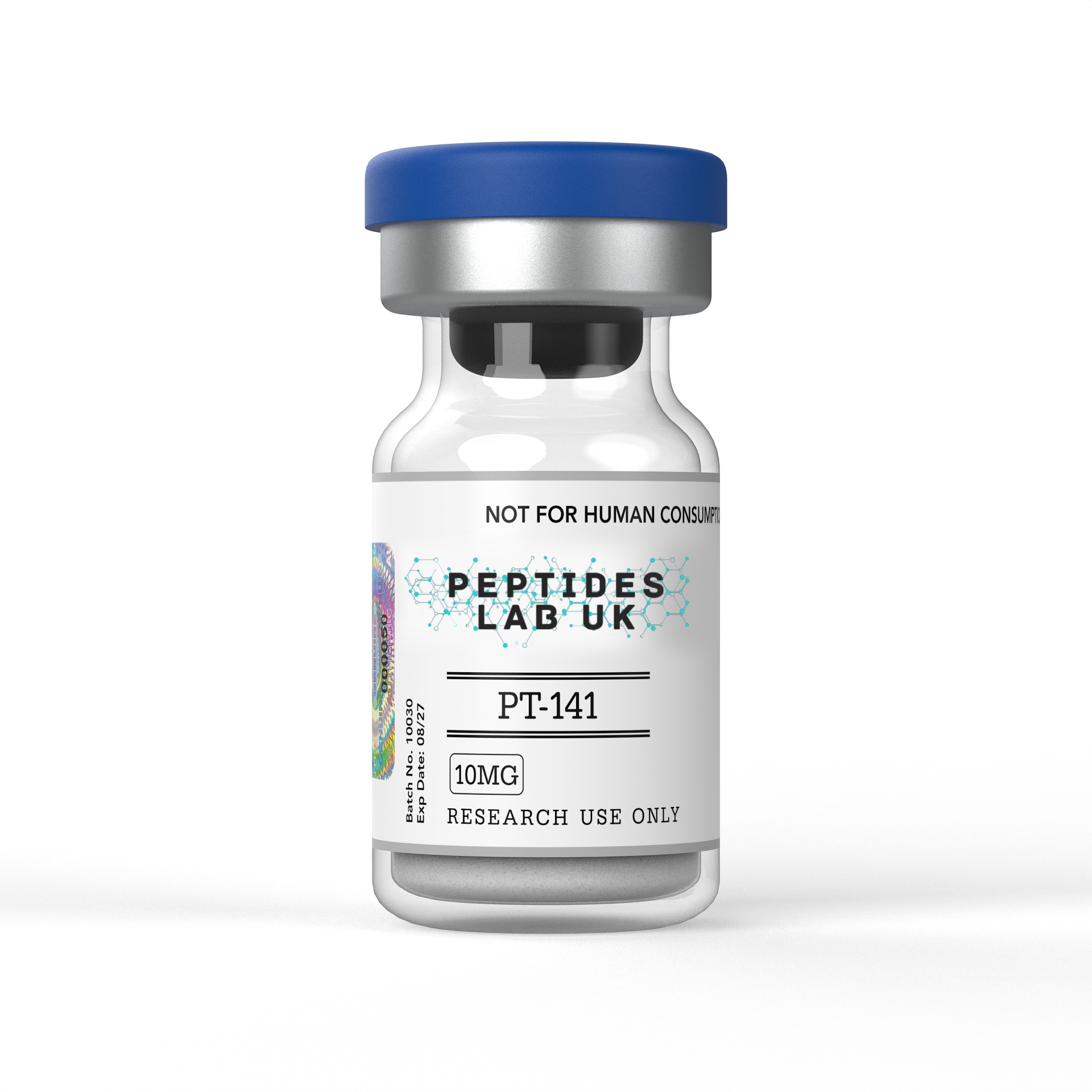
PT-141, chemically designated bremelanotide, is a cyclic heptapeptide analogue of alpha-melanocyte-stimulating hormone (alpha-MSH) and a non-selective melanocortin receptor agonist. Its lactam-bridged cyclic structure distinguishes it from linear alpha-MSH analogues, conferring greater resistance to enzymatic degradation and a defined, constrained receptor-binding conformation. PT-141 peptide research is centred on its selective activity at the MC3R and MC4R melanocortin receptor subtypes, expressed predominantly within hypothalamic and limbic regions of the central nervous system, distinguishing its mechanism from peripheral, vascular-based pharmacological approaches. Within laboratory research, PT-141 is used to study central melanocortin receptor pharmacology, hypothalamic neural signalling, and receptor-binding kinetics in cell and animal models.
What Is PT-141 Peptide?
PT-141 is a cyclic heptapeptide with a molecular weight of approximately 1,025 Da, structurally derived from Melanotan II through targeted modification. Its development followed observations during clinical testing of Melanotan II, in which researchers noted unexpected and consistent pro-erectile effects in male trial participants, prompting further investigation of the melanocortin receptor system as a research target distinct from Melanotan II’s primary pigmentation-related applications. Bremelanotide was subsequently developed as a more selective, research-refined derivative of that parent compound.
Structurally, PT-141 retains the His-Phe-Arg-Trp core sequence found in alpha-MSH, representing the minimal pharmacophore required for melanocortin receptor engagement. The defining structural feature that distinguishes PT-141 from linear alpha-MSH analogues is its lactam bridge, a covalent cyclisation that constrains the peptide into a defined three-dimensional conformation. This cyclic constraint serves two research-relevant functions: it enhances metabolic stability by limiting the peptide’s susceptibility to exopeptidase degradation relative to linear analogues, and it creates a binding conformation that fits the melanocortin receptor pocket with high affinity, particularly at MC4R. Published pharmacokinetic data describe an elimination half-life of approximately 2.7 hours, with reported receptor-mediated signalling effects persisting beyond the plasma half-life, a distinction relevant to researchers designing receptor-binding and downstream signalling assay timelines.
A central distinction in PT-141 research, relevant to understanding its scope, is that its principal mechanism operates through the central nervous system rather than through peripheral vascular pathways. This distinguishes bremelanotide research fundamentally from research on phosphodiesterase-5 (PDE5) inhibitor compounds, which act through peripheral vascular smooth muscle relaxation via the nitric oxide/cGMP pathway. PT-141 instead engages melanocortin receptors expressed in hypothalamic and limbic brain regions, meaning that its research relevance lies specifically in central neural pathway investigation rather than peripheral vascular pharmacology, a distinction that shapes the cell and animal models in which it is typically studied.
Mechanism of Action
PT-141 acts as an agonist across multiple melanocortin receptor subtypes, including MC1R, MC3R, MC4R and MC5R, but its research-relevant activity is understood to be mediated primarily through MC3R and MC4R, the two subtypes most densely expressed in hypothalamic nuclei and limbic structures involved in motivational behaviour. Receptor binding studies have demonstrated that PT-141 shows negligible activity at MC2R and comparatively reduced activity at MC1R relative to its parent compound Melanotan II, reflecting the structural modifications introduced during its development that shifted receptor selectivity toward the centrally expressed subtypes.
Within the hypothalamus, MC4R is expressed with particular density in the paraventricular nucleus (PVN), a region serving as a key integration point for neuroendocrine and autonomic signalling. Research using MC4R knockout animal models has demonstrated abolished physiological responses to melanocortin receptor agonists in this pathway, providing strong pharmacological evidence that MC4R is an essential mediator of the centrally regulated responses associated with PT-141 administration in animal studies. Upon receptor binding, PT-141 activates adenylyl cyclase, initiating a Gs-protein-coupled cyclic adenosine monophosphate (cAMP) signalling cascade that modulates downstream neurotransmitter release within hypothalamic and limbic neural circuits.
Downstream of receptor activation, published research describes modulation of central dopaminergic and oxytocinergic signalling pathways. Activation of MC4R-expressing neurons in the hypothalamus has been associated in animal studies with increased dopaminergic neurotransmission in circuits linked to motivated behaviour, alongside proposed interaction with oxytocinergic signalling relevant to social and motivational neural circuits. Systemic administration of PT-141 to rats has been reported to activate neurons in the hypothalamus, demonstrated through increased c-Fos immunoreactivity, a standard marker of neuronal activation used in preclinical neuroscience research, with anatomical tracing studies using pseudorabies virus further supporting connectivity between this hypothalamic region and peripheral autonomic pathways in rodent models.
A defining mechanistic distinction documented in the PT-141 literature is the compound’s independence from nitric-oxide-dependent vascular stimulation, the pathway exploited by PDE5 inhibitor pharmacology. Because PT-141’s activity is centred on melanocortin receptor engagement within the central nervous system rather than on peripheral vascular smooth muscle, its mechanism is described in the comparative pharmacology literature as operating through an entirely orthogonal pathway relative to nitric-oxide/cGMP-based vascular agents. This mechanistic distinction is a central reason for continued research interest in the melanocortin pathway as a subject of central-nervous-system pharmacology, independent of any peripheral vascular mechanism.
What the Research Shows
An early mechanistic study characterising PT-141 as a melanocortin receptor agonist reported that administration to rats and nonhuman primates activated central melanocortin receptors including MC3R and MC4R, expressed primarily within the central nervous system, and demonstrated that systemic administration in rats produced increased c-Fos immunoreactivity in hypothalamic neurons, alongside anatomical tracing evidence linking this hypothalamic region to peripheral autonomic circuits via pseudorabies virus tract-tracing (PT-141 melanocortin receptor mechanism study).
Clinical-stage research on bremelanotide has been documented in two identically designed, randomised, double-blind, placebo-controlled Phase 3 trials, known as the RECONNECT studies, which evaluated subcutaneous bremelanotide administered as needed over a 24-week treatment period in premenopausal study participants. Co-primary efficacy endpoints assessed in these trials included standardised questionnaire-based measures of sexual desire and associated distress, with the trial authors reporting a favourable safety profile in which most treatment-emergent adverse events were mild to moderate in intensity (bremelanotide Phase 3 RECONNECT trials).
A related Phase 2b dose-ranging study examined responder analyses across different bremelanotide dose levels, characterising how efficacy outcomes varied by administered dose in a controlled clinical research setting, data that has informed subsequent dose selection in later-stage clinical research protocols (Phase 2b dose-ranging responder analysis).
Receptor pharmacology research using MC4R knockout animal models has separately established the receptor’s essential role in mediating melanocortin agonist activity, with knockout models showing abolished physiological responses to compounds acting at this receptor subtype, providing converging pharmacological evidence for the central mechanism described above. Researchers examining the broader melanocortin receptor family have also documented that PT-141’s receptor selectivity profile, weighted toward MC3R and MC4R relative to MC1R, distinguishes its research applications from earlier, less selective melanocortin agonists such as Melanotan II, from which it was derived.
Research Applications
Within laboratory settings, PT-141 research peptide is used across several distinct research contexts related to central melanocortin signalling. Central nervous system receptor binding assays represent a core application, in which researchers use radioligand or fluorescence-based binding techniques to characterise PT-141’s affinity and selectivity profile across the MC1R, MC3R, MC4R and MC5R receptor subtypes, often in comparative studies alongside other melanocortin agonists including Melanotan II and native alpha-MSH.
Hypothalamic signalling models constitute a further significant research area, using techniques such as c-Fos immunohistochemistry to map neuronal activation patterns in the hypothalamus and associated limbic structures following peptide administration in animal models, building on the foundational activation studies described in the research literature. Dopamine pathway mapping research examines the downstream neurotransmitter effects of MC4R activation, using microdialysis or related neurochemical sampling techniques in rodent models to characterise how central melanocortin receptor engagement translates into altered dopaminergic signalling within relevant motivational circuits.
Neuro-endocrine studies form a broader category encompassing research into how hypothalamic melanocortin signalling interacts with the hypothalamic-pituitary axis and related neuroendocrine regulatory networks, an area of ongoing preclinical investigation given the anatomical overlap between melanocortin receptor expression and broader neuroendocrine control centres. When selecting a certified PT-141 research peptide for central neural signalling or melanocortin receptor assays, researchers should confirm the correct cyclic structure and lactam bridge integrity in the supplied documentation, since the peptide’s defining structural constraint is directly relevant to receptor-binding assay reproducibility.
Purity, Storage and Handling
Research-grade PT-141 should be accompanied by a certificate of analysis confirming purity by HPLC, typically at or above 98 percent, together with mass spectrometry verification confirming the correct cyclic heptapeptide structure, molecular weight of approximately 1,025 Da, and intact lactam bridge. Because PT-141’s biological activity depends specifically on its constrained cyclic conformation, verification that the lactam bridge has not been compromised during synthesis or storage is particularly relevant to reproducing receptor-binding and signalling assay findings reported in the primary literature. When evaluating high-purity pt 141 peptide for laboratory research, UK researchers should verify that each batch includes this documentation rather than relying on a generic product listing.
Lyophilised PT-141 should be stored at -20°C, protected from light and moisture, in order to preserve peptide integrity and cyclic structure prior to reconstitution. Buffer compatibility should be confirmed prior to reconstitution, since the compound’s cyclic structure and receptor-binding activity can be sensitive to buffer pH and composition in ways that differ from linear peptide analogues. Once reconstituted, PT-141 should be refrigerated at 2-8°C, used within the supplier’s stated stability window, and protected from repeated freeze-thaw cycling through appropriate aliquoting, since reconstituted cyclic peptides remain susceptible to degradation through oxidation and hydrolysis over extended handling periods.
Frequently Asked Questions
How does PT-141’s cyclic structure differ from linear alpha-MSH analogues?
PT-141 contains a lactam bridge that cyclises the peptide into a constrained three-dimensional conformation, distinguishing it from linear alpha-MSH analogues. This structural constraint enhances resistance to enzymatic degradation and creates a defined binding conformation that engages the MC3R and MC4R receptor pocket with high affinity.
Why is PT-141 described as selective for MC3R and MC4R?
Receptor binding studies report that PT-141 shows negligible activity at MC2R and reduced activity at MC1R relative to its parent compound Melanotan II, with functional activity concentrated at MC3R and MC4R, the receptor subtypes most densely expressed in hypothalamic and limbic regions relevant to central nervous system research.
Does PT-141 act through the same pathway as PDE5 inhibitor compounds?
No. PT-141 operates centrally through melanocortin receptor activation in the hypothalamus and limbic system, distinct from PDE5 inhibitors, which act through peripheral vascular smooth muscle relaxation via the nitric oxide/cGMP pathway. This orthogonal mechanism is a key reason for its continued research relevance in central nervous system pharmacology.
How should research-grade PT-141 be verified before use in an assay?
Researchers should request a batch-specific certificate of analysis confirming HPLC purity of 98 percent or higher and mass spectrometry confirmation of the correct cyclic structure and intact lactam bridge, since the peptide’s constrained conformation is directly relevant to reproducing receptor-binding assay findings.
PT-141 peptide, as supplied by Peptides Lab UK and comparable UK research suppliers, is intended strictly for in-vitro and animal-model laboratory research. It is not licensed or intended for human or veterinary use, and nothing in this article should be interpreted as guidance for personal administration.