
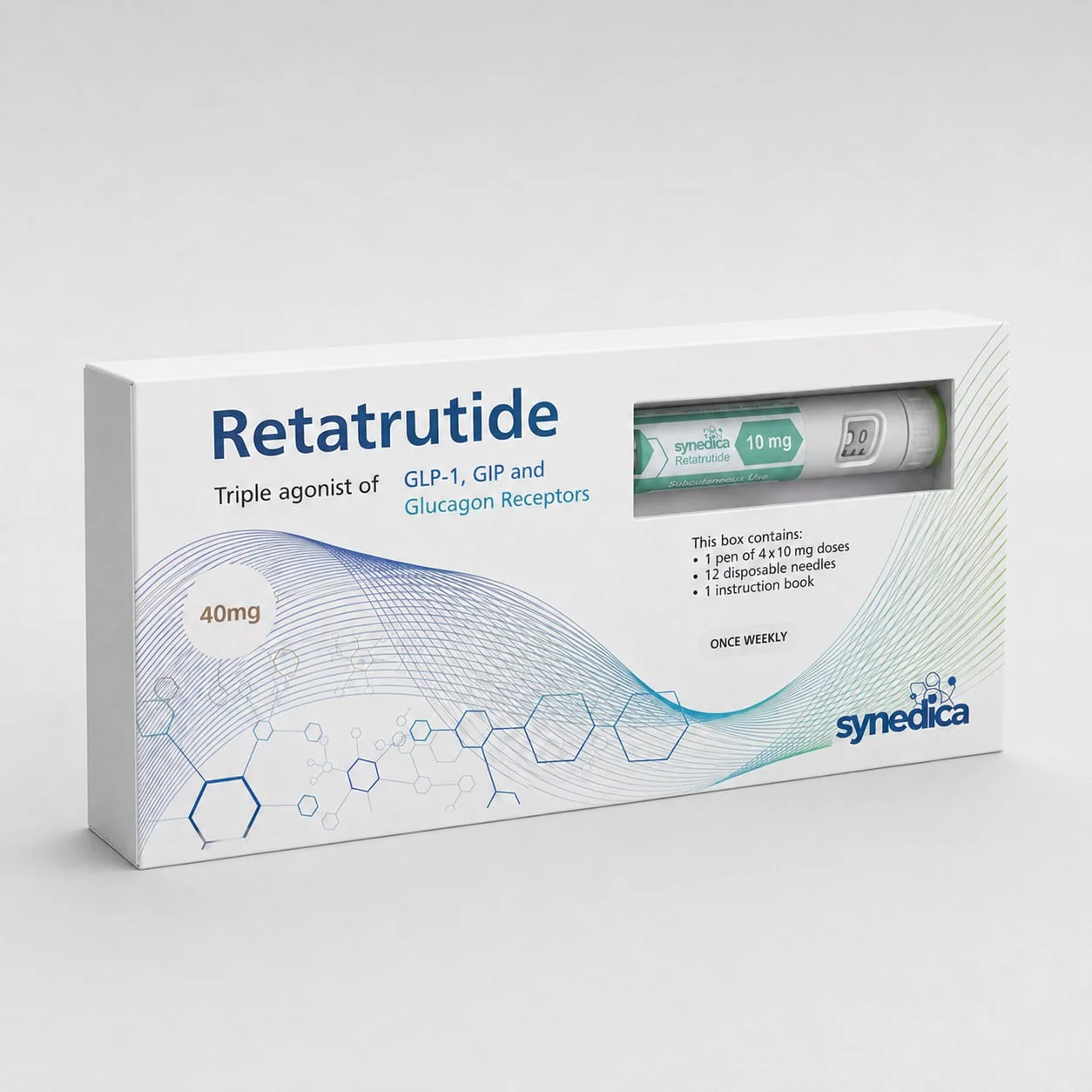
Most articles about retatrutide side effects are written by people who have not read the trial data. They rewrite each other, blend clinical findings with user anecdotes, and present the result with a confidence the underlying evidence does not support.
This is an attempt to do the opposite. Everything below comes from published trial reporting. Where the literature is silent, this article says so rather than filling the gap.
One framing note before starting: this is a review of adverse-event data as recorded in research. It is not medical advice, not a safety endorsement, and not a guide to using anything. Retatrutide is an unapproved investigational compound.
Why the Retatrutide Side Effect Question Is Harder Than It Looks
The first problem is population. Trial participants are not a cross-section of the public. They are screened, monitored, and withdrawn if certain parameters move. Adverse-event rates observed under that regime are not the rates you would see in an unsupervised setting, and no published study claims otherwise.
The second problem is reporting method. Trials count adverse events in defined categories over defined windows. A trial that records “nausea” is not telling you how severe it was for any individual, how long it lasted, or whether it recurred. Aggregate percentages compress very different experiences into a single number.
The third problem is duration. The retatrutide programme has years of follow-up, not decades. Any statement about long-term effects is extrapolation, and should be read as such.
With those three caveats in place, here is what the data actually contains.
The GI Signal
Gastrointestinal events are the dominant finding, and they are consistent across the incretin class rather than unique to retatrutide.
Nausea, vomiting, diarrhoea, and constipation appear at elevated rates relative to placebo in the published phase 2 reporting, with a dose-dependent pattern — higher dose arms, higher incidence. The 2023 dose-ranging trial published in the New England Journal of Medicine reported these events as the most common treatment-emergent findings.
This is mechanistically unsurprising. GLP-1 receptor activation slows gastric emptying and alters gut motility. Any compound engaging that pathway produces GI effects in a meaningful proportion of subjects. The dual agonists showed the same profile before retatrutide existed.
What matters practically is that GI events drove discontinuation in the trials. A percentage of participants stopped treatment because of them. That is the honest measure of how tolerable the class is under observation — not the headline incidence rate, which includes a large number of mild, transient cases.
The Glucagon Question
Retatrutide’s third receptor target is what separates it from tirzepatide and semaglutide, and it is also where the more interesting safety questions sit.
Glucagon receptor agonism increases hepatic glucose output and mobilises energy stores. That is the mechanism behind the increased energy expenditure researchers are interested in — and it is also why hepatic parameters and cardiac measures are monitored closely in this programme rather than assumed benign.
Published trial data has not reported a hepatic or cardiac safety signal that halted development. That is a materially different statement from “no hepatic or cardiac effects exist.” It means the monitoring did not surface anything requiring the programme to stop. The distinction matters, and it is routinely lost in secondary coverage.
Glucagon agonism also raises questions about heart rate. Some incretin-class compounds have shown modest heart rate increases in trial reporting. Anyone tracking the retatrutide literature should be watching resting heart rate data in the phase 3 readouts specifically, because that is where a population-level signal would become visible.
How Retatrutide Compares on Tolerability
The most useful context for any single compound is the class it belongs to.
Tirzepatide engages GIP and GLP-1. Semaglutide engages GLP-1 alone. Retatrutide engages GIP, GLP-1, and glucagon. The GI profile is broadly shared across all three because the GI effects are driven by the incretin arm they have in common. The glucagon arm is where the profiles diverge, and where the monitoring burden increases.
A side-by-side breakdown of the receptor mechanisms, published endpoints, and documentation standards is covered in retatrutide compared with tirzepatide — useful if you want the comparative picture rather than a single-compound summary.
The short version: expect the GI profile to be similar to the rest of the class, expect the metabolic and cardiac monitoring to be tighter than for the dual agonists, and expect the long-term picture to be the least established of the three, because it has the shortest follow-up.
The Adverse Events Nobody Lists
Secondary coverage almost always stops at nausea. The published reporting contains more.
Injection-site reactions appear in the trial data at low rates, as they do across injectable peptides. Hypersensitivity reactions are reported at low frequency. There are reports of appetite reduction so pronounced that nutritional intake becomes a monitoring concern rather than a benefit — a detail that gets lost when appetite suppression is framed purely as an outcome measure.
None of these are unique to retatrutide. All of them appear in the class literature. The point is that a side-effect article which lists only nausea and vomiting has read the abstract, not the paper.
What the Data Cannot Tell You
Four things, and they are not minor.
It cannot tell you individual risk. Trial percentages describe populations. No published figure converts into a prediction for one person.
It cannot tell you about long-term use. The follow-up periods are measured in months to a few years. Effects that emerge over a decade are, by definition, not in the data.
It cannot tell you about real-world use. Monitored trial participants differ from any other population in adherence, screening, and clinical oversight. Observed rates under supervision are the best-case version of the profile.
It cannot tell you about interactions. Polypharmacy was largely excluded from trial enrolment. Anyone extrapolating trial safety to a general population with comorbidities and concomitant medicines is extrapolating well past the evidence.
Why Documentation Still Matters
A side-effect article that ignores material quality is incomplete, because the adverse-event profile in the literature describes a specific thing: pharmaceutical-grade material, defined dose, verified identity.
Research supply is a different category of product. Identity confirmation, stated purity, batch traceability, and a named testing laboratory are the variables that separate documented material from undocumented material — and undocumented material introduces a risk profile that no published trial has ever measured, because no trial has used it.
Researchers working with compounds in this class should hold suppliers to those standards regardless of which compound they are studying. retatrutide research material supplied with a batch-linked certificate and a stated analytical method is a starting point, not a guarantee — but it is the difference between a variable you have controlled and one you have not.
The Honest Position
Retatrutide’s published side-effect profile is dominated by GI events that are shared across the incretin class, dose-dependent, and frequent enough to have caused discontinuation in trials. The glucagon arm introduces hepatic and cardiac monitoring requirements that the dual agonists do not carry to the same degree. The long-term picture is genuinely unknown because the follow-up does not yet exist.
That is a less comfortable summary than either the marketing version or the alarmist version. It also happens to be what the data says.
—
About the Author
United Peptides Research Team writes on analytical standards, batch documentation, and sourcing practice in the research peptide supply chain. United Peptides is a UK supplier of research-grade peptides. All material discussed is supplied strictly for laboratory research use only, is not intended for human consumption, and is not medical advice