
A few laps in the pool can leave the arms, legs, and stomach muscles feeling like they have all done a workout. That’s because swimming requires several muscle groups to work together to move the body through water. Each stroke uses these muscles differently, making swimming an effective way to build strength, coordination, and endurance without the heavy impact of many land-based exercises.
Your Back Muscles Do More Work Than You Think
The latissimus dorsi, commonly called the lats, are large muscles that extend along both sides of the back. During freestyle and backstroke, these muscles help pull the upper arms through the water, contributing to forward movement. The trapezius and rhomboids also support shoulder blade movement, allowing swimmers to maintain control as their arms recover above the surface. Strong back muscles help produce an effective pull without relying entirely on the shoulders.
Backstroke places different demands on these muscles because swimmers rotate their arms while facing upward. Proper body rotation allows the back and shoulders to share the workload instead of forcing one muscle group to handle excessive strain. Swimmers who develop balanced upper-body strength often find it easier to maintain consistent strokes over longer distances.
Shoulders, Chest, and Arms Work Together With Every Pull
Swimming involves repeated movements of the shoulder joints, supported by the deltoids and rotator cuff muscles. The deltoids help lift and position the arms, while the rotator cuff stabilizes the shoulder during each stroke. Chest muscles, particularly the pectoralis major, assist with movements that bring the arms toward the body, including the pulling phase of breaststroke.
Arm muscles also contribute to propulsion and control. The biceps help bend the elbows during underwater pulling movements, while the triceps straighten the arms during certain stroke phases. Poor technique can place unnecessary stress on the shoulder joints, which is why swimmers benefit from learning proper arm positioning before increasing their training distance.
Why Core Strength Matters More Than Swimming Speed
The abdominal muscles, obliques, and deeper core muscles stabilize the body as it moves through water. Without adequate core control, the hips may drop, increasing drag and forcing the arms and legs to work harder. During freestyle, the obliques help control body rotation, allowing swimmers to turn smoothly without twisting excessively. Butterfly places additional demands on the abdominal and lower back muscles because the stroke requires coordinated wave-like movement through the torso. Even beginners who are still developing their technique use their core to maintain balance while floating, kicking, and changing positions.
Your Legs Provide More Than Just Kicking Power
The quadriceps, hamstrings, glutes, and calf muscles contribute to kicking movements. Freestyle and backstroke use alternating flutter kicks, with movement beginning at the hips and continuing through the knees and ankles. The glutes help drive hip movement, while the quadriceps and hamstrings control leg extension and bending. Relaxed ankles allow the feet to move water more efficiently.
Breaststroke uses a different pattern that places greater emphasis on the inner thigh muscles, including the hip adductors. Swimmers bend their knees, turn their feet outward, and press their legs backward and together to generate propulsion. Proper timing matters because kicking too early or allowing the knees to spread excessively can increase resistance and reduce efficiency.
Young Swimmers Develop Muscle Coordination Through Basic Movements
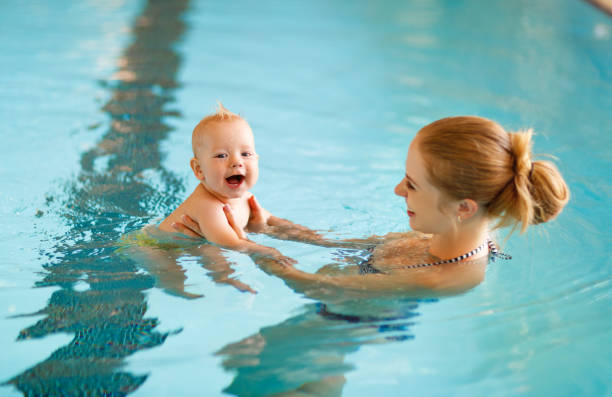
Children begin using many of these muscle groups before learning complete swimming strokes. Supported floating, gentle kicking, and reaching for floating objects introduce movements that involve the arms, legs, and trunk. Infant swim lessons focus on age-appropriate water familiarization rather than strength training, but these supervised activities can provide opportunities to practice basic movement patterns.
As children grow, structured instruction helps them coordinate separate movements into complete swimming skills. Parents searching for swimming lessons near me can look for programs that introduce techniques gradually and match activities to each child’s physical development. Proper supervision remains essential, regardless of a child’s swimming ability.
How Professional Instruction Helps Swimmers Use Their Muscles Efficiently
Knowing which muscles swimming activates is useful, but effective movement depends on how those muscles work together. An overly forceful kick, stiff shoulders, or poor body alignment can waste energy and make swimming unnecessarily tiring. Instructors can identify these problems and teach adjustments that help students move more smoothly through the water.
Muscle coordination develops through consistent practice, appropriate technique, and gradual increases in difficulty. Safe Splash Huntsville offers Huntsville swimming lessons for children and adults at different experience levels, including beginners learning basic movements and swimmers improving their strokes. Families and individuals interested in developing swimming skills can consider the school’s programs to learn how proper technique supports better movement, balance, and control in the pool.