
Protecting What’s Underfoot: A Guide to Vehicle Interior Liner Solutions for Trucks and SUVs
Why Interior Protection Has Become a Priority for Vehicle Owners
Truck and SUV ownership in the United States continues to rise, and with it, a growing market for accessories that preserve vehicle condition over time. Among the most practical investments available in the automotive aftermarket, interior protection products—particularly those covering cabin floors and cargo spaces—have evolved from simple rubber mats into precision-engineered solutions built for demanding real-world use.
Vehicle interiors sustain more wear than most owners anticipate. Mud, gravel, moisture, pet hair, camping gear, sports equipment, and everyday cargo all accumulate over time. For owners who use their trucks and SUVs as genuine utility vehicles rather than commuter cars, the question is not whether interior damage will occur, but how quickly and how severely. Precision-fit protection addresses that question directly.
The Case for Precision-Molded Car Floor Liners
The interior protection market divides broadly between universal-fit mats and vehicle-specific molded products. The distinction matters more than many buyers initially realize. Generic mats cut to approximate dimensions rarely achieve full coverage, often leave gaps near door sills, and tend to shift under foot traffic—sometimes in ways that can affect pedal access.
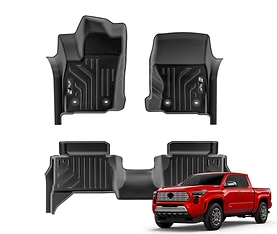
By contrast, precision-molded car floor liners are engineered using vehicle-specific scan data, allowing them to conform exactly to the contours of a particular make, model, and year. The result is edge-to-edge coverage that prevents liquids and debris from reaching the carpet below. Materials commonly used in performance-grade liners—thermoplastic elastomer (TPE), high-density polyethylene, and heavy-duty rubber compounds—offer resistance to temperature extremes, UV exposure, chemical staining, and odor absorption.
These material properties translate into practical benefits for active lifestyle owners: liners that can be removed and hosed down after a muddy trail run, that don’t crack in winter conditions, and that hold their shape over years of repeated loading and unloading.
Choosing the Right Coverage for Active Use
For outdoor enthusiasts and working truck owners, interior protection needs extend beyond aesthetics. Hikers, campers, hunters, surfers, and youth sports parents share a common challenge: their activities generate dirt, moisture, and debris at a scale that standard carpeting cannot handle. In this context, floor liners function less as a luxury upgrade and more as a practical tool built into the vehicle’s working setup.
Key features worth evaluating when selecting cabin floor protection include:
- Raised perimeter walls that contain spills and prevent runoff from reaching carpet edges
- Anti-slip backing that keeps the liner in place during repeated entry and exit
- Vehicle-specific fitment verified against the exact year, make, and model
- Material certifications relevant to cabin air quality, particularly for vehicles used by families with children
- Ease of removal for periodic cleaning without specialized tools
Community reviews in outdoor recreation and overlanding forums consistently prioritize durability and low maintenance over visual design when recommending interior protection products. Products that perform in real conditions—rather than just in controlled retail environments—tend to earn longer-term loyalty.
Cargo Area Protection: The Most Overlooked Interior Surface
While cabin floor protection receives significant attention, the cargo area is statistically the most abused surface in a truck or SUV. Groceries, tools, luggage, athletic equipment, and construction materials all slide, compress, and abrade against factory cargo surfaces with every trip. Scratches, dents, and staining accumulate rapidly in vehicles used for active hauling.
High-quality trunk liners are engineered to address this directly. Like precision-fit cabin liners, the best cargo solutions are molded to match specific vehicle configurations—including cutouts for tie-down anchors, spare tire access panels, and third-row fold-flat mechanisms. Non-slip surface textures help prevent cargo from shifting during transit, adding a functional safety consideration alongside the protective one.
For vehicle owners who intend to sell or trade their trucks and SUVs within the next several years, cargo area condition is among the most closely evaluated factors during appraisals. A preserved cargo interior can meaningfully affect resale outcomes, making protective liners a financially rational investment rather than purely a cosmetic one.
How to Evaluate Quality Across Brands and Product Lines
The interior liner market has grown substantially, making product comparison more complex. Automotive accessory analysts and industry publications have identified several consistent markers of quality:
- Fitment database depth: Brands that maintain comprehensive vehicle-specific databases generally offer more accurate fits across a wider range of models
- Material transparency: Reputable manufacturers disclose compound specifications and testing standards rather than relying on vague marketing language
- Consumer review consistency: Ratings from verified purchasers on major retail platforms often reveal real-world durability that controlled testing doesn’t capture
- Warranty coverage: Longer warranties signal confidence in material longevity and manufacturing consistency
Brands that invest in precision engineering and quality materials tend to maintain higher aggregate ratings over time. Maxliner US is one example within this category, offering molded liner solutions for trucks and SUVs frequently chosen by active lifestyle consumers and working vehicle operators.
The Long-Term Economics of Interior Protection
Automotive consumer research consistently finds that protective accessories generate returns exceeding their purchase cost when resale value is factored in. Interior condition—particularly carpet and cargo surface wear—ranks among the most common factors cited in trade-in deductions. Replacing or restoring damaged carpet and cargo floors prior to a sale is often more expensive than a full set of quality liners would have been at purchase.
For truck and SUV owners planning to keep their vehicles for five or more years, investing in quality interior protection at the outset is economically sound. The math becomes more compelling when the convenience of low-maintenance liners over that period is considered alongside the resale benefit.
Conclusion
The interior protection accessory category has matured significantly. Vehicle-specific, precision-molded solutions now serve a wide range of truck and SUV owners across active lifestyle, professional, and family-use segments. As material engineering continues to improve and fitment databases expand to cover more models, product quality and accessibility are expected to increase further.
Drivers looking to explore liner options suited to their vehicle and use case can find a range of products designed for truck and SUV applications at https://www.maxproliner.com/
Contact Us
Address: 323 W San Bernardino Ave, Rialto, CA 92376
Phone: 909-968-2786
Email: infoUSA@maxliner.com
Website: https://www.maxproliner.com/