
Every company talks about deep work, but most offices are designed for constant interruption. Open plans, endless notifications and video calls make it hard for teams to find real focus. That is why more leaders are quietly adding intentional analog rituals to their workplaces – small anchors that reset attention and create space for meaningful conversation. One of the most surprisingly effective? A well‑designed chess corner.
Chess is not just a game; it is a structured way to train long‑term thinking, pattern recognition and patience. In a workspace context, it becomes a low‑stakes arena where colleagues can practice strategy without slides, KPIs or dashboards. The key is to integrate the game into the office environment in a way that feels premium and deliberate, not like a random plastic set thrown on the nearest table.
Handcrafted chess table tops work particularly well in collaboration zones and meeting rooms. Placing a high‑quality board on a shared table sends a clear signal: this is a space where we expect thinking, not just status updates. Teams can use the board to warm up before a strategy session, decompress after a tough call or keep a standing game going across the week. Because the board looks like a piece of furniture rather than a toy, it elevates the room instead of cluttering it.
For lounges and informal areas, wall‑mounted and vertical chess boards solve the classic space problem. They turn a blank wall into an interactive focal point, giving people something to do that is more intentional than scrolling a phone. A vertical board near the coffee point or in a quiet corner invites short, thoughtful breaks that actually restore attention. Colleagues can make one move between tasks, turning the board into an ongoing, shared narrative that runs alongside their work.
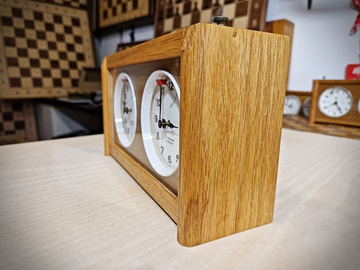
Adding a wooden or vintage‑style chess clock introduces a subtle layer of urgency and playfulness. Timeboxing is a core productivity technique; a chess clock simply gives it a tangible, almost ceremonial form. Two people can use it for quick “strategy sprints”, brainstorming rounds or friendly games during breaks. The audible click of the button and the visible countdown reinforce the idea that focused time is valuable and finite, without feeling like yet another app.
In a landscape dominated by digital productivity tools, a thoughtfully designed chess corner stands out precisely because it is physical, quiet and human. It shows that the company values depth over noise, strategy over constant reaction, and shared rituals over yet another notification. For teams trying to build a culture of deliberate, high‑quality work, that might be the most powerful growth signal of all.